After a quick stop in Beaufort, North Carolina to visit some
cruising friends, our next stop was Virginia, a state with much history and
much to see. The rolling hills, elegant homes and historic towns are beautiful.
This state, as one of the original 13 colonies, and the one that produced eight
of our Presidents was a big part of the country’s history, much of which is pretty
bloody.
The first stop was Ashland, VA as it was equidistant from
several areas we wanted to see.
One of the first places we visited was Fredericksburg where
we began with the self-guided walking tour of Marye’s Heights.
 |
| This house was here during the battles fought in the Civil War and belonged to Marye. |
More than one
battle was fought here during the Civil War and 15,000 men lost their lives
on the pretty grassy hill.
 |
| The inside of the house was riddled with bullets. |
The worst fight, December 13, 1862, was the assault
of Major General Ambrose E. Burnside and nine divisions comprised of 30,000
Union troops. The Confederate soldiers were hunkered down on a “sunken road”
behind a rock wall as wave after wave of Union soldiers charged UP a fairly
gentle rise toward them. There was nowhere to hide and the boys in blue were
mowed down by the thousands. To stand at the top of the hill and envision that
awful battle and the obscene bloodshed is stunning. On the hill above the road
is a cemetery where many of those who died there are buried.
 |
| Monument to Richard Rowland Kirkland, "The Angel of Marye's Heights. |
As we walked the path along the curve of the hill, we came
to a beautiful statue erected in memory of Richard Rowland Kirkland who was a
member of the South Carolina Volunteers. During the night of the massacre,
wounded Union soldiers who were able, retreated to the bottom of the hill. The following
morning there were still thousands who lay dying and many were pleading for
aid. Kirkland requested and received permission from his commanding officer to
help and, at the risk of being killed himself, took water and blankets to the
fallen soldiers. He came to be known as the The Angel of Marye’s Heights. It
was an especially moving story and almost brought me to my tears.
 |
| Mary Washington's home. |
After leaving Marye’s Heights we drove into the lovely town
of Fredericksburg. Here we found the home of George Washington’s mother, Mary,
and the Rising Sun Tavern which was originally built by George’s younger
brother, Charles, as a home. The town dates back to 1676 and many of the
buildings are still standing.
We were rather hoping for a cold beverage at the Rising Sun
but, alas, these days it is only a replica of a pub. A young woman in period
dress gave us a tour of the place with an interesting dialog about life in the
days when the Rising Sun was actually a tavern. She explained that I, as a
woman, would be sequestered in a small room and not allowed in the main parlor
or dining room where my husband and the other men would be eating, drinking
& playing games like poker & whist. Nor would I be able to share the
sleeping accommodations with him unless he was exceptionally well to do and
could afford the only room available for couples.
 |
| A fat (well fed) leech. Eww! |
The tour of the Hugh Mercer Apothecary was very interesting
as well. The young docent explained some of the torturous medical practices of
the 1700’s & 1800’s, held a quite lively leech in his hand and shared many
of the herbs and spices that were, and still are, used to treat diseases and
symptoms. Among other things, we still use ginger to cure motion sickness and lobelia
to calm nerves.
 |
| Some buildings were not in great shape. |
 |
| Some were beautifully restored. |
Fredericksburg, like many of the towns on the east coast,
has quite a few buildings dating back to the 1600’s. Some have been lovingly restored.
Some haven’t. While wandering along main street we were approached by a woman in
her 60’s (at least) who just wanted to say hello, inquire where we were from
and tell us a little about the town. She explained that she is “restoring” her
home and planning to turn it into a bed & breakfast. Though she was
fascinating to talk with, Chris & I have our doubts about the house. It had
a substantial amount of dry rot and the porch looked like you would fall right
through it. Still, one had to give her an “A” for effort and tenacity.
“Colonial” Williamsburg was next and was not exactly what I’d
expected. While it is another town from the 1600’s that has been restored and
peopled with folks in period costume who explained what life was like back
then, it was more along the lines of a theme park without the cotton candy and
thrill rides. John D. Rockefeller, Jr. was responsible for the restoration of
Williamsburg and his foundation takes care of the maintenance, upkeep &
improvements. The folks who work in the park spend their days recreating daily
life in the 1700’s.
 |
| Harnessing the Oxen to the plow to go work in the field. |
After paying our admission (which was fairly substantial)
we entered through the “slave quarters” where we watched as a man hitched up a
team of oxen and used them to plow a section of field.
 |
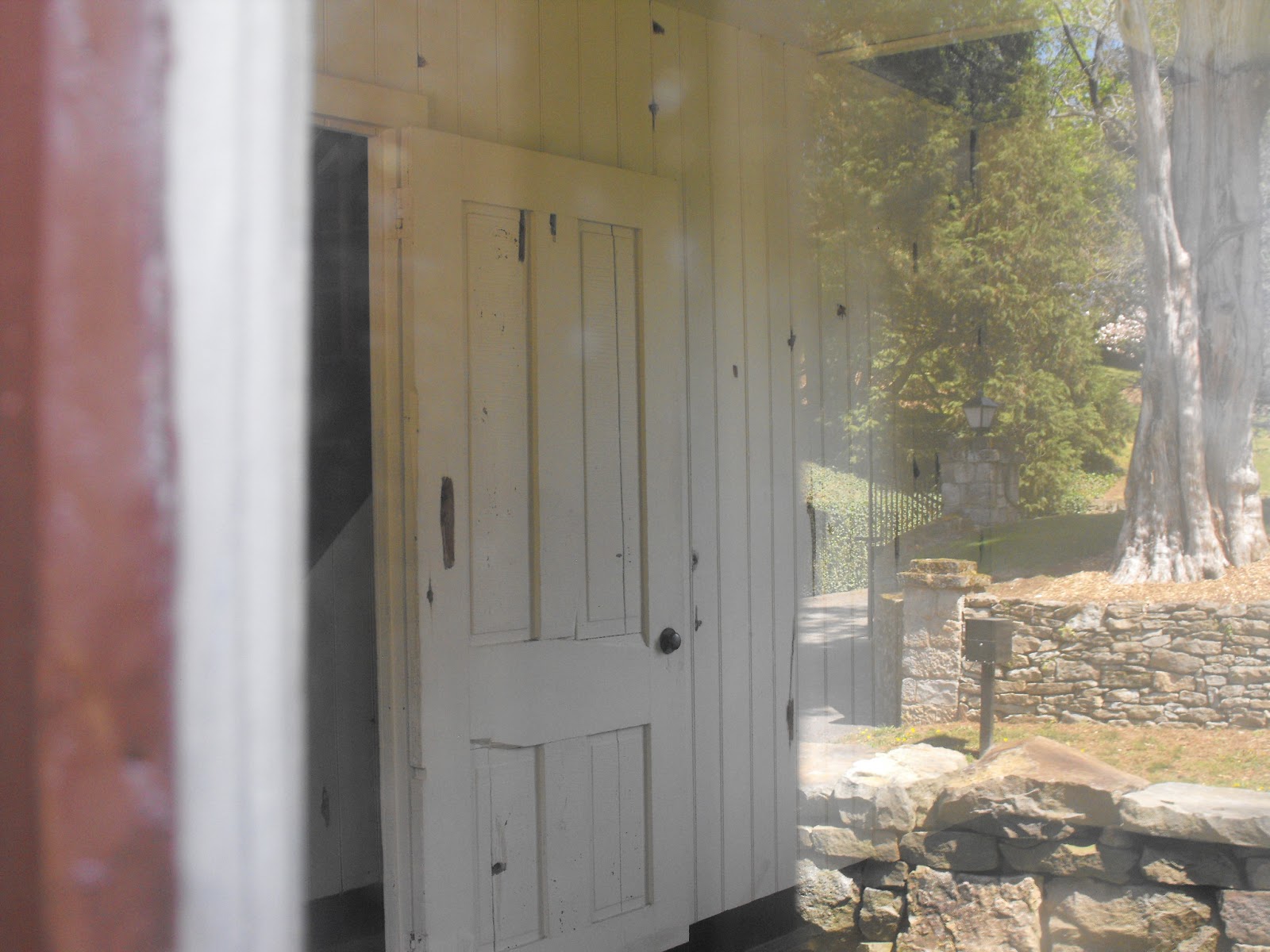
| Slave cabin in Williamsburg. |
Walking through the
small slave cabin, two young women who were huddled by the fire in the chill,
talked about the living conditions of slaves and farmers during that time. As
we continued on through the forest into downtown Williamsburg, a wandering
preacher welcomed us and spent some time trying to save our souls.
 |
| "WHO will come and join the effort..." |
At one
point, while we were exploring the town, we came upon a military man who was
recruiting volunteers for the militia. He was looking for anyone over 15 and
under 60 to join up for the cause. A few youngsters were convinced to sign up
though they were a rather sad lot when it came to following directions.
Fortunately, Chris was outside the age limit, so we continued on down the street.
At the Post Office, we mailed a couple postcards which the Postmaster hand
stamped “Williamsburg”. I hope the recipients got a kick out of that.
 |
| Learning the Virginia Reel. |
As we
left the Post Office we came upon a young “crier” inviting us to a dance
demonstration. Well, we must have misunderstood the definition as it wasn’t a
demonstration of dances…it was a dance lesson! We had a great time learning to
dance the Virginia Reel.
 |
| Armory building |
The tour of the armory was pretty interesting. During that
time in history, guns were very expensive so ALL the weapons and supplies for
the militia were kept in the armory building. At the first sign of trouble an
alarm was sounded and all the men came running to get their guns and defend the
town.
 |
| Springtime Tulips |
 |
| The Trellis and shops to explore. |
It was pretty chilly that day so we stopped into the Trellis
restaurant for lunch, spent a little time perusing the many gift and specialty
shops and then drove back to the RV for a little wine and a good night’s sleep.